
 EN
EN RU
RU
Pay offers and different reference periods
Kommersant reported on 8 October 2026 that the median advertised courier salary in Russia on HeadHunter reached 190,000 roubles in September, up 38.7 per cent over a year. Avito’s employment service put its third-quarter median at 134,600 roubles, up 31 per cent. These are measures from different platforms and periods. Job advertisements do not measure the actual earnings received by every courier.
Parcels and courier services are different measures
Data Insight estimated online shopping with delivery in the first half of 2026 at 4.5 billion parcels, up 32 per cent from the corresponding period a year earlier. Retailers’ own services accounted for 91.3 per cent of shipments, conventional logistics operators for 4.2 per cent and retail online imports for 4.5 per cent.
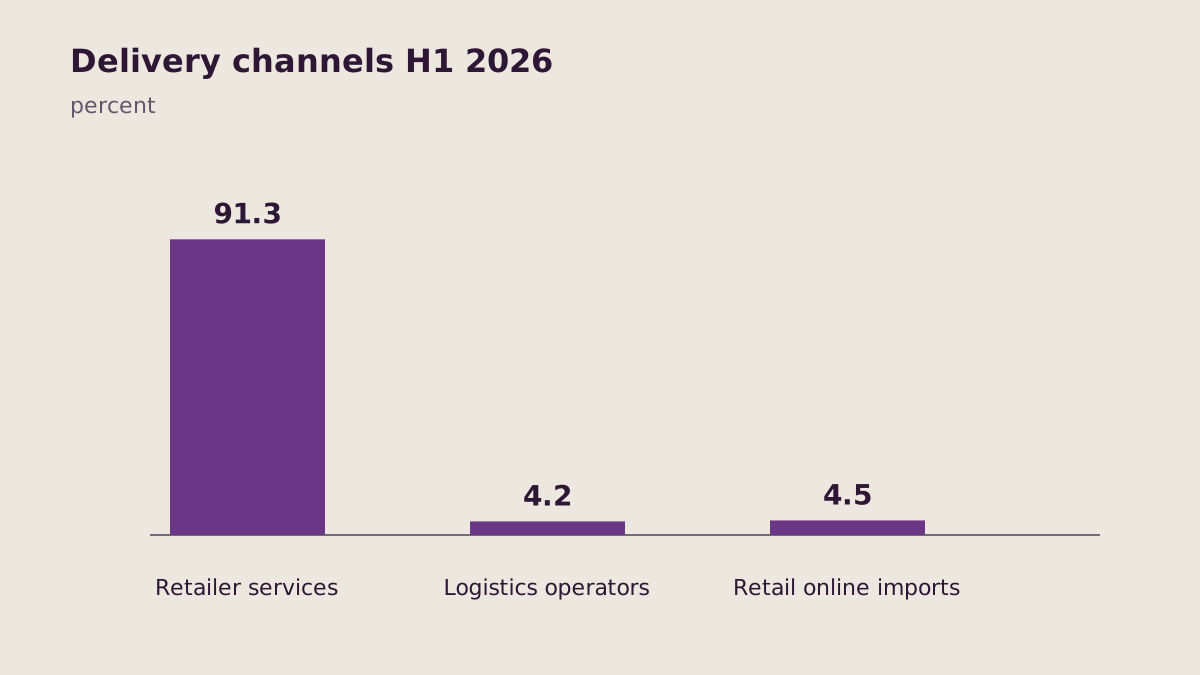
The same research company’s full-year report for 2025 estimated the market at 7.7 billion parcels, growing by 24.9 per cent. Domestic shipments represented 96.4 per cent of the total. Wildberries and Ozon together accounted for 6.48 billion parcels, or 84.1 per cent of the market. The five largest conventional operators recorded a 1.7 per cent decline, while other logistics companies declined by 13.9 per cent. These figures describe a historical full year. They cannot be equated with the first-half changes of 2026 or interpreted as a count of employed workers.
An earlier last-mile study covering the first three quarters of 2022 estimated delivered orders at 1,700 million. Retailers’ own delivery services then held an 86 per cent share, compared with 75 per cent in 2021. Researchers associated the main change with the largest marketplaces. The report shows that the organization of delivery was changing before the current salary announcement. Those historical measures retain their period and methodology. They describe the distribution of shipments between services, rather than establishing a particular cause of the increase in advertised courier pay in September 2026.
Sales value is distinct from delivery numbers
The Association of Internet Trade Companies publishes a separate series with Sber2B. Its table for 2025 presents a total of 13.19 trillion roubles: 12.736 trillion in the domestic market and 454 billion in cross-border trade. The page also shows the regional distribution of domestic sales, with Moscow accounting for 15.5 per cent. These are monetary purchase measures, rather than parcel counts or a courier payroll. Regional shares refer to that defined market. They do not automatically determine how job advertisements are distributed between cities, delivery services or different forms of employment.
Grocery delivery has its own statistics
Data Insight’s August 2026 bulletin contains July results: 99 million grocery orders and 149.5 billion roubles in online sales. Annual growth was 26 per cent for orders and 31 per cent for sales, with an average order value of 1,511 roubles. The different rates reflect separate measurement of order numbers and monetary value. The segment comprises online shops and grocery-delivery services, rather than all electronic commerce. July results also have a different reference period from September pay offers. The shared word delivery does not make these figures a single statistical series.
A study of restaurant and café delivery published in October 2025 examined the customer journey using 1,263 respondents. Its scope included devices used, direct ordering or aggregators, apps or websites and types of venue. This approach treats receiving prepared food as a particular customer activity. It describes decisions about channels and brands, rather than the payroll of a courier service. The study supplies context for the variety of orders: restaurant delivery is examined through its own sample and questions, which differ from the accounting used to measure the number of logistics parcels.
A November 2025 publication about replenishing grocery supplies sets out a different research purpose. Data Insight considered the journey from recognizing a need to receiving a purchase, including express delivery, shops, delivery services and marketplaces. The report’s scope included collection, couriers and pickup points, basket size, ordering frequency and reasons for choosing a retailer. These categories show how researchers distinguish ways of receiving groceries. The published contents do not give each channel’s share. They define the subject of analysis without establishing a particular purchasing frequency for all Russian consumers.
Geography was changing before the current season
A 2023 logistics study identified increased marketplace purchases, staffing shortages and insufficient warehouse space among the factors reshaping the sector. It also reported a decline in Moscow’s share of online orders, from more than a quarter in 2021 to less than a fifth in 2023. The order share increased in most regions covered. This is a dated observation about electronic commerce and demand distribution. It supplies historical geographical context, while providing neither the structure of 2026 job advertisements nor evidence that one specific region determined the latest advertised-pay median.
Pickup points form a separate network
In July 2025, 5Post, an X5 subsidiary, reviewed seven years of operations. It reported 156 million delivered orders and 29.6 million unique users over its history. Its network then covered more than 4,400 settlements in 72 regions, with over 23,500 collection and dispatch points in Pyaterochka and Perekrestok stores. This is an operator’s accumulated result at a particular date. It describes receipt through retail-store infrastructure, rather than the number of courier deliveries to doors in one year. The cumulative period is essential to interpreting both the order and user figures.
In June 2025, 5Post and Yandex Delivery announced a pilot for intercity shipments between individuals through the Yandex Go app. The plan connected dispatch from more than 16,000 Yandex Market collection points with receipt at 22,857 partner locations in 63 regions. This was a particular partnership between networks, explicitly described as a pilot. It illustrates the combination of infrastructures within one service. The announcement does not mean every parcel was ultimately taken to an apartment by a courier, or that the number of listed locations corresponds to the number of workers.
A separate June 2025 announcement concerned acquiring companies operating under the TopDelivery brand to develop door-to-door delivery. 5Post associated the transaction with adding a courier service to its existing collection offering. Its 2025 plans referred to 64 regions with collection in Moscow, followed by geographical expansion and person-to-person shipments in 2026. Here pickup networks and delivery to doors are presented as different parts of the offer. The published expansion plan remains a plan. It does not, by itself, demonstrate that each of the intended stages had subsequently been completed.
Platform transaction value differs from revenue
Yandex’s February 2026 release on its 2025 results helps distinguish corporate measures. Annual gross transaction value in electronic-commerce services was 1,211 billion roubles, while revenue was 465.3 billion. The segment’s adjusted earnings before interest, tax, depreciation and amortisation remained negative at minus 39.6 billion roubles. These measures cover a defined corporate segment, rather than the whole Russian market. They are also not the sum of courier compensation. Order value, company revenue and financial results describe different aspects of operating a platform within the same reporting period.
In its first-quarter 2026 report, Yandex described individual services separately. Lavka’s transaction value rose by 27 per cent annually, Eats by 17 per cent and Delivery’s Russian transaction value by 31 per cent. External business customers in intracity express delivery recorded 87 per cent growth. These are different activities, distinguishing groceries, prepared food and logistics services for businesses. The quarterly rates describe transaction value, rather than compensation for a working shift. They cannot be combined into one measure of the number of courier assignments without additional information about orders.
The second-quarter 2026 release reported electronic commerce reaching adjusted earnings before interest, tax, depreciation and amortisation breakeven for the first time. Its table showed 0.4 billion roubles for the quarter, while the first-half result remained negative at minus 6 billion. The company described efficiency work and changes to its marketing model. Keeping the period visible matters: one positive quarter does not make the preceding six-month result positive. The release describes corporate service economics. It does not establish how much of the improvement came specifically from courier costs or changes in advertised salaries.
Robot-production plans have their own deadlines
In October 2025, Yandex announced an intention to produce 1,300 delivery robots a month within a year and reach 20,000 new-generation units by the end of 2027. It associated the programme with courier shortages and reducing delivery costs. The same release reported more than 250,000 robot deliveries completed during 2025 by its publication date. Production targets concern the future, whereas completed orders describe accumulated work. The proposed device output is not the number of people actually replaced. Both the time reference and the unit being counted need to remain distinct.
In March 2026, the company reported more than a million orders delivered by robots over their history and two million kilometres travelled. New areas were still preparing for launch, with mapping robots creating detailed local maps. Nizhny Novgorod was scheduled by the end of June, while some locations near Moscow and in Kazan were planned for April. These details concern preparation in particular places. Accumulated kilometres and orders are different from monthly activity or the number of devices in operation. The release distinguished existing service from intended local geographical expansion.
A May 2026 release recorded the actual launch in Nizhny Novgorod. Robots began taking Lavka groceries, prepared food and everyday products to the Sormovsky, Kanavinsky and Moskovsky districts. The company identified it as the fourth Russian city of more than a million residents with the service and described expansion in other urban areas. This is a later operating milestone than the March plan. District-level coverage still matters: a service operating in a city is not necessarily available at every address. The announcement specifies operating areas, rather than uniform infrastructure across the entire city.
Robots and people can perform different order stages
In May 2026, Yandex introduced combined delivery to apartments. A robot collects an order from a shop, restaurant or dark store and takes it to the building; a nearby courier receives the package and brings it upstairs. The person is paid for completed orders, and one courier can work with several robots. Initially, the format served some Lavka customers in Moscow and St Petersburg. The company described fewer long journeys and maintaining income through more assignments. This is the stated service model, rather than a published measurement of earnings for every participant.
Warehouse automation differs from street delivery
In August 2025, Yandex Robotics and Lavka announced their first robotic dark store. A designated area at the Moscow site used 12 mobile robots and 84 shelving units, occupying 28 per cent of the floor area. Robots brought shelves to employees, while people continued to pick perishable and frozen products. The company reported order-picking acceleration above 30 per cent. This concerns an internal warehouse process, distinct from carrying an order along a street. A measure from one location is not a change in every courier’s productivity or in average delivery time across the network.
A September 2025 partnership with Perekrestok concerned a distribution centre and more than 100 robots for preparing orders for supermarkets in St Petersburg and the surrounding region. Coordination used Yandex Robotics’ own management system to synchronize different devices and their routes. This is another logistics stage, moving and preparing goods before retail service to the final customer. A distribution centre differs from both a small dark store and a street-delivery robot. An equipment-deployment announcement therefore does not directly identify how many courier vacancies disappeared or were created because of that project.
A route depends on an order’s constraints
Yandex Routing documentation describes arrival windows, order weight and dimensions, service time at the recipient and warehouse loading time. A hard window requires arrival within the interval, while a soft window permits a deviation with an additional penalty in the planning model. The documentation explicitly states that narrower windows, other things equal, require more vehicles to fulfil orders on time. This is a specific relationship between planning parameters and resources. It explains why order counts alone do not describe the logistics task: time, freight and service requirements are separately considered.
Shift work is measured differently from vacancies
Data Insight and Ventra Go!’s study for 2025 estimated platform solutions for temporary work at approximately 239 billion roubles and 360,000 full-time-equivalent working years. The latter measures labour volume, rather than the same number of individual people. Its methodology combined desk research, expert estimates, interviews and a survey of 1,452 employed citizens. The study covered several industries, including retail and logistics. It describes platform-based shift work more broadly than the courier occupation. Neither its market value nor labour-volume estimate can be directly equated with advertisements for permanent job vacancies.
International research distinguishes platform types
The International Labour Organization’s 2021 report examined online platforms and services where work is performed at a particular location. It drew on surveys and interviews with about 12,000 workers and representatives of 85 businesses across different sectors. That coverage supported analysis of work organization and business experience alongside workers’ conditions. This is international research with its own period and sample. It demonstrates distinctions between forms of digital labour, while providing no estimate of Russian courier salaries in 2026. Results from one country cannot simply characterize every delivery service without examining their scope.
Comparison requires a common counting unit
The joint OECD, ILO and European Union handbook of 2023 proposes a measurement framework for platform work. Its definition includes an app or platform organizing essential features such as access to clients, work allocation, evaluation and payments. It also specifies at least one hour during the selected reference period. The handbook discusses different statistical sources and the risk of undercounting participants. These parameters explain why registered accounts, active workers and full-time employment are not interchangeable measures. Comparison requires matching both the definition of participation and the period used to count it.
Platform work can provide supplementary income
Eurostat’s 2022 pilot survey covered 17 EU and EFTA countries. Among people aged 15–64, one per cent reported at least one hour delivering food or goods through a platform in the preceding year. Among participants with platform work in the preceding month, 52.2 per cent said platform income represented less than a quarter of their personal earned income. These refer to different periods and groups within one survey. The results describe a supplementary-income arrangement, rather than a full-time Russian courier salary. They retain the boundaries of the European sample and its 2022 reference year.
Counting all participants remains a research problem
The ILO’s February 2026 research brief on digital platforms and workers emphasizes persistent measurement gaps. It says existing sources are insufficient to estimate all individuals engaged in platform employment accurately because of limitations in coverage and data availability. The authors connect comparability with internationally agreed statistical standards. This is a separate finding about information quality that matters when interpreting labour markets. The brief does not turn platform numbers into worker numbers or establish an exact global courier population, its share in Russian employment or the level of actual monthly earnings.
Different units of measurement
- Parcels measure shipment volume.
- Platform transaction value differs from revenue.
- Full-time equivalents measure labour volume.







HOT NEWS INTERNATIONAL
Leave a comment