
 EN
EN RU
RU
A possible reopening of diesel exports becomes commercially useful only when permission, physical fuel and a deliverable cargo come together. Russia’s latest statement leaves those conditions unresolved. Buyers therefore face a planning problem: how to preserve access to an additional source without counting fuel that has not yet been released.
On 2 October, Deputy Prime Minister Alexander Novak said Russia would consider partly reopening diesel exports if production exceeded domestic demand. Reuters reported the remarks after the government extended restrictions for fuel producers through October. Novak described the domestic market as balanced. His words described a conditional option, not an export authorisation, a volume commitment or a loading schedule.
A balance statement has a limited meaning
Balance is a relationship between supply and demand within the area and period being measured. It does not establish that every customer can obtain every specification at every terminal. Refinery output can be sufficient in aggregate while a particular district experiences a delivery delay. Storage, rail capacity, road access and maintenance schedules can all separate national availability from local access. This distinction matters because an export decision may depend on more than the headline production total.
The phrase “if production exceeds domestic demand” also leaves the measurement window open. A temporary improvement might appear in a daily operating report without persisting through the next maintenance period. Equally, demand can move with weather, agricultural operations or transport schedules. Those are general features of fuel planning, rather than developments established by this report. The announcement supplies no published threshold that outside buyers can use to calculate when the condition will be met.
For a purchasing manager, the practical result is a need to keep an option separate from a commitment. An option belongs in a list of possible suppliers and scenarios. A commitment belongs in the delivery plan only after the supplier can demonstrate an authorised shipment, a defined product and a realistic movement schedule. Confusing those categories can leave a business with an apparently adequate supply plan that depends on unavailable fuel.
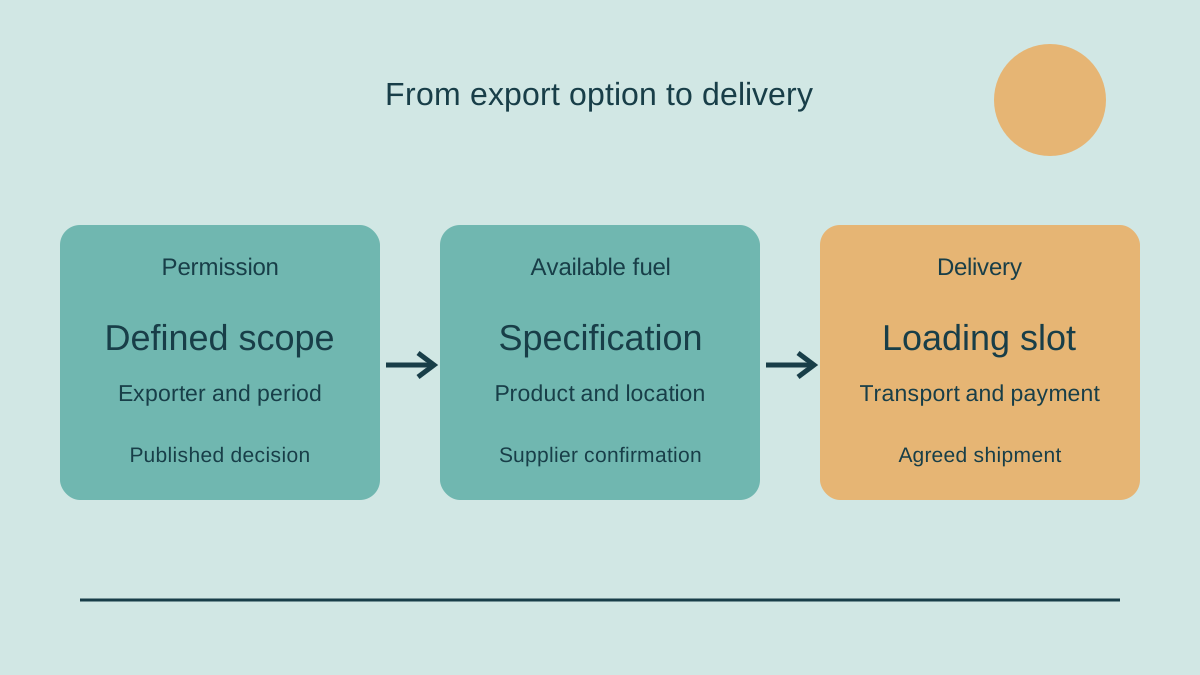
Permission and shipment are separate gates
Policy can change faster than physical logistics. A public statement may be followed by an administrative decision, but the decision itself does not put diesel on a vessel. Exporters still need product in the correct location, a workable contract, financing, transport and an acceptable destination. Each element can become the limiting step. A partial relaxation could therefore have a narrower practical effect than its headline suggests.
“Partial” is particularly significant. It could refer to a limited group of exporters, specified quantities or a restricted period, but the remarks reported by Reuters do not provide those details. None of these possibilities should be presented as the chosen design. Until the applicable decision is published, readers cannot know whether their intended supplier or shipment would qualify. A general expectation of relaxation is insufficient evidence for a particular trade.
There is also a difference between an authorised cargo and a cargo that can lawfully and commercially reach a buyer. Restrictions imposed by other jurisdictions, transport providers’ policies and a bank’s own controls can remain relevant. This article does not establish the legal eligibility of any transaction. The operational point is narrower: a seller’s ability to export cannot by itself prove that every other participant is able to carry, finance or receive the shipment.
Evidence that changes a purchasing decision
- The published decision defines the permitted exporter, product and period.
- The seller confirms available fuel, specification and a loading location.
- The proposed transport and payment arrangements are feasible for that transaction.
- The delivery window fits the buyer’s consumption and storage requirements.
- The contract states what happens if permission or loading is delayed.
This sequence is an analytical framework for assessing a possible supply opening, not a description of a completed government process. Its value lies in revealing where the evidence stops. A buyer may have satisfactory information about fuel quality while still lacking clarity on permission. Another may have permission but no suitable loading slot. Those are different risks and need different responses.
Domestic resilience can take priority over export timing
Reuters also reported Novak’s comments about attacks on energy infrastructure and repair work. Those statements should remain attributed to him; they do not provide an independently verified inventory of damaged equipment or restored capacity. For commercial planning, the relevant uncertainty is whether output and distribution can remain reliable long enough to support exports after domestic requirements are met.
A refinery’s operating status is not a simple switch between fully closed and fully available. Different units process different streams, and a disruption can change the mix of products rather than stop all output. Repairs can restore one operation while another remains constrained. The report does not identify a plant-level production series that would justify estimating additional diesel tonnage. Readers should resist turning general statements about faster repairs into a numerical supply forecast.
Domestic reserves may also serve as a buffer against the next interruption. Whether authorities choose to build that buffer or release an export surplus is a policy question left open by the announcement. A balanced current market can coexist with a preference for caution. The same published condition might thus support different decisions depending on the resilience officials believe is required. Outside buyers cannot infer a release date from the balance description alone.
Price signals do not prove physical availability
Expectations of additional supply can influence negotiations before any cargo changes hands. A buyer may seek a lower offer because a new source could become available; a seller may argue that the option remains uncertain. Neither position establishes a realised change in freight, terminal availability or landed cost. An expectation can affect a quoted price while the underlying delivery problem remains unresolved.
The useful comparison is the complete delivered product. A headline fuel quotation excludes many costs that determine whether a shipment is attractive: freight, insurance, financing, terminal handling, storage and losses. Differences in specification or timing can also change its value. A nominally cheaper cargo can be more expensive for a buyer who must hold it for an extended period or adapt operations to a different product grade.
These components should be compared on the same basis. A prompt delivered offer and a future loading offer are not interchangeable. Nor should a price for one location be treated as a universal price for all buyers. The Reuters report does not publish a consistent set of transaction offers from which to estimate a market-wide saving. The article therefore makes no forecast that partial reopening will produce a particular price decline.
The inventory decision depends on consumption
A business that uses diesel must connect purchasing to its own operating schedule. Transport fleets, construction equipment and backup generators have different patterns of demand. The same additional shipment can be helpful to one customer and impractical for another. Storage capacity, product turnover and the timing of supplier deliveries determine whether a possible new source reduces risk or simply ties up cash.
Buying earlier than necessary can protect continuity, but it also consumes working capital. Waiting for a possible export opening can preserve cash while increasing exposure to another delay. Neither choice is automatically superior. The appropriate question is how long the business can operate with confirmed supply and what it would do if the next delivery arrived later than planned. That question can be answered from the business’s own records without inventing a forecast about Russian export policy.
A sound stock report distinguishes physical inventory, contracted fuel awaiting delivery and uncommitted enquiries. Adding all three together obscures the certainty of supply. Only physical stock is already available for consumption, while even a signed delivery may carry conditions. Potential offers arising from a policy statement are further removed. This hierarchy helps managers avoid treating a discussion with a seller as equivalent to fuel in their own tank.
Contracts need a clear response to delay
When a shipment depends on a future permission, the commercial agreement should make that dependency visible. Buyers and sellers need to know which event activates the delivery obligation and what evidence demonstrates it. They also need a shared understanding of the loading period and the remedy if it is missed. Those are issues to resolve in the actual transaction rather than assumptions an editorial article can settle.
An unclear dependency can transfer uncertainty between parties without anyone noticing. A seller may regard an offer as conditional on authorisation, while a buyer reads it as a firm promise. The disagreement becomes expensive only when the expected cargo does not arrive. Recording the condition early allows the purchasing team to keep backup arrangements and prevents sales language from becoming an unsupported operating assumption.
Backup supply has its own value and cost. Maintaining another supplier may involve a reservation charge, a different product specification or less favourable delivery terms. That cost should be compared with the disruption the business is trying to avoid. It should not be dismissed merely because a possible new exporter offers an attractive indicative price. A cheap option can remain useful without replacing the confirmed source that keeps operations running.
Different participants see different constraints
A refinery, trader, haulier and end user can read the same statement differently. The producer may focus on domestic offtake and its operating programme. A trader may focus on which buyers can receive additional product. A carrier may need a reliable loading slot, while an end user may care most about delivery before an existing tank runs low. An improvement for one participant does not automatically solve another participant’s problem.
This explains why a national supply opening may appear uneven across a market. Some buyers have storage, established transport arrangements and a suitable contract ready to activate. Others need time to assemble those elements. The report does not identify winners or quantify that difference. It does suggest why shipment evidence should be assessed at the level of the actual supply chain rather than extrapolated from a single national statement.
Communication between these participants is therefore as important as monitoring announcements. A purchasing team benefits from asking its supplier which step is still pending and who controls it. “Waiting for permission” and “waiting for a ship” describe different paths to delivery. A useful update names the unresolved event rather than repeating that discussions are progressing. That makes it possible to adjust the backup plan when the relevant risk changes.
Keep the comparison current without rewriting history
Supply assessments also need a consistent record of when each piece of information became available. A statement on one day, a contract offer on another and a loading confirmation later are separate observations. If they are merged into a single retrospective account, a team may believe it knew more at the time of purchase than it actually did. Preserving the sequence helps evaluate whether the decision was reasonable with the evidence then available.
The record should also show which assumptions changed. A buyer might initially expect an authorisation before its next delivery, then revise that expectation when the decision remains unpublished. That revision is useful even if the product price has not changed. It tells the operating team that the uncertainty now concerns timing rather than cost. Such distinctions support clearer communication between purchasing, finance and the staff responsible for continuity.
There is no need to turn every rumour into a new forecast. The purpose of monitoring is to identify evidence that changes an actual decision: whether to activate backup supply, accept a confirmed offer or continue watching an option. A short dated record of the unresolved gate can be more useful than a elaborate projection unsupported by published quantities. In this case, the absence of a defined export allocation remains a central fact.
What would demonstrate a real change
The next meaningful evidence would be a defined export decision followed by credible shipment arrangements. The first would establish the scope of permission; the second would show whether the permitted fuel can actually reach customers. Reported cargo movements could then help distinguish an announced possibility from realised trade. None of that evidence is supplied by the remarks alone, and this article does not claim that reopening has already happened.
For now, the sensible commercial interpretation is conditional availability. Novak’s statement creates a reason to follow the domestic balance and subsequent decisions, but it does not remove the need for confirmed procurement. The essential distinction remains between a possible surplus and deliverable fuel. Businesses that preserve that distinction can keep an additional supply route under review while basing their operating commitments on evidence they can verify.




















HOT NEWS INTERNATIONAL
Leave a comment