
 EN
EN RU
RU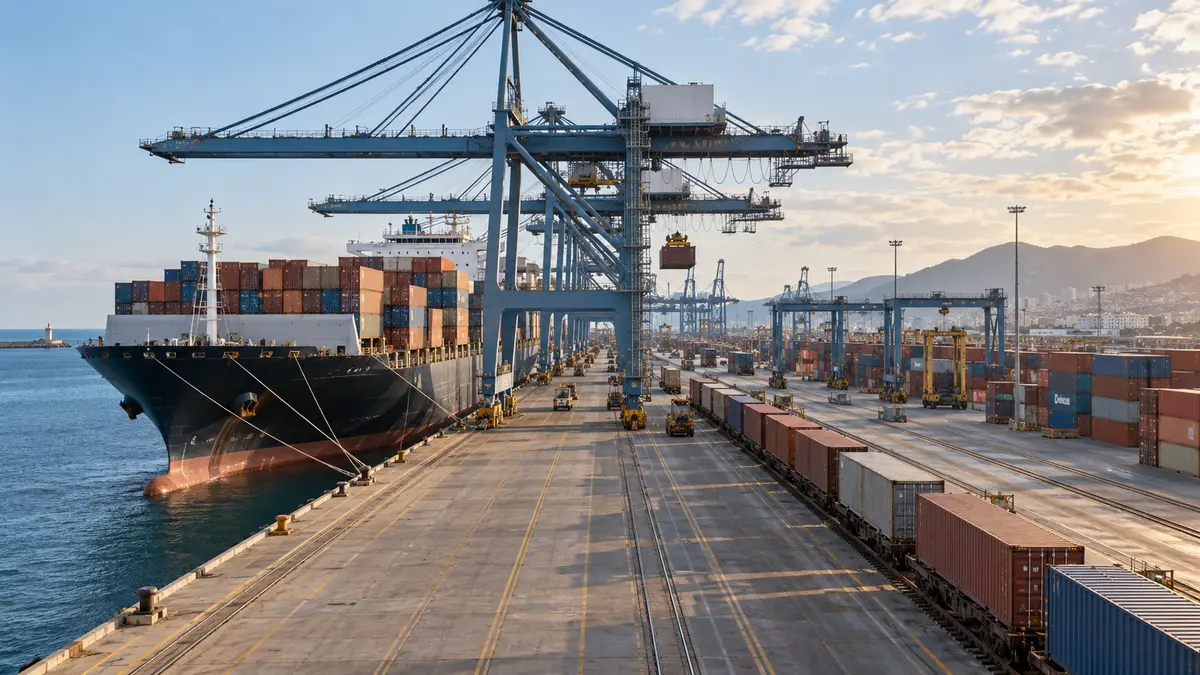
Terminal investment becomes a question about the whole route
A new freight terminal is a visible investment: land, handling equipment, storage and connections can all be identified. A dependable international service is less visible because it depends on how several facilities work together. Rhenus’s Middle Corridor expansion therefore raises a specific commercial question. Can investment in individual transfer points produce a connected service that cargo owners can actually plan around, rather than merely increase the sum of capacities listed on project presentations?
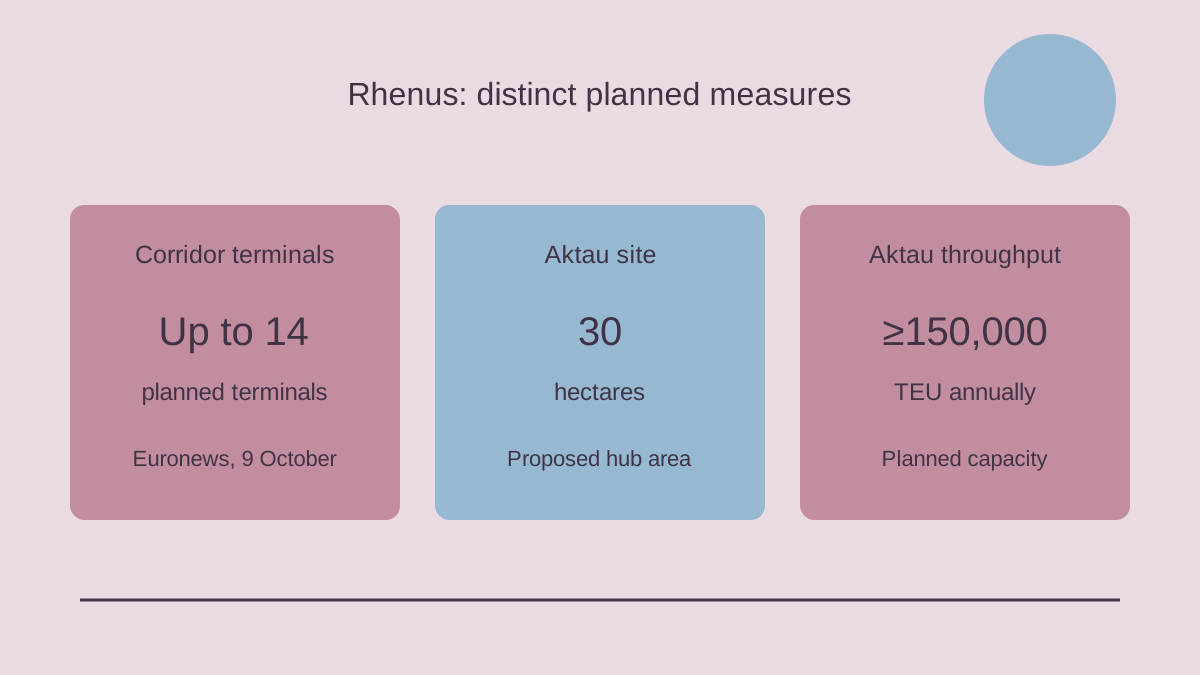
Euronews reported on 9 October 2026 that Rhenus chief executive Tobias Bartz envisaged up to 14 terminals from Uzbekistan, through Kazakhstan and Azerbaijan, to Türkiye. He linked the plan to a European network with 23 container ports and around 70 port facilities. The report also described a planned Andijan upgrade of around €11 million, targeting roughly 200,000 TEU annually.
The words “up to”, “planned” and “targeting” are material. They describe an intended network, not a completed set of assets operating at the announced throughput. The business value depends on what is built, what demand it serves and how the connections function. An investor or shipper can recognise the strategic direction without treating every announced capacity as freight already moving.
What the Aktau agreement actually advances
Rhenus’s 30 September release identifies cooperation with Aktau International Sea Trade Port and Kazakhstan Temir Zholy, led by Yelzhas Otynshiyev. The proposed trimodal terminal connects sea, rail and road on at least 30 hectares, with at least 150,000 TEU of additional annual handling capacity. Traffic analysis and technical-economic feasibility assessment remain next steps.
This describes project preparation with a defined purpose. The agreement helps establish the partners and the scope of further work, while the next steps test whether the design corresponds to viable demand and operations. A feasibility assessment matters because a terminal’s nominal handling capability is useful only if the surrounding service can supply and remove cargo at compatible rates.
The announcement also shows why the terminal should be assessed as an interface. Sea, rail and road do not simply add their individual strengths automatically. Cargo must move between them, information must remain consistent and responsibility must be clear while the shipment changes hands. The terminal investment can improve that interface, but the service around it determines how much of the physical capability becomes commercially usable.
Designed capacity and observed traffic are different measures
The planned Aktau handling figure is an annual design measure for a particular facility. A reported corridor traffic total concerns observed movement across a route and period. They should not be presented as equivalent observations or placed into a chart that implies the project has already doubled actual trade. The units may resemble each other, but the objects being measured and the status of the numbers differ.
A terminal can also handle movements that do not correspond one-for-one with a corridor’s counted through-transit containers. Storage, regional distribution and transfers can contribute to its workload. Without the underlying statistical definitions, a direct capacity-to-traffic comparison can obscure those distinctions. The meaningful question is whether the proposed facility can resolve a specific operational constraint under a clearly defined traffic scenario.
TEU is a standard container-capacity expression, not a count of commercial contracts, individual products or revenue. It allows container activity to be expressed on a common basis, while leaving the contents and value of shipments outside the measure. Commercial analysis needs those distinctions because physical throughput and the economic worth of a logistics service are connected but do not describe the same outcome.
The corridor is more than an alternative between two endpoints
The World Bank’s November 2023 analysis focuses on Kazakhstan, Azerbaijan and Georgia. It argues that suitable investment and policies could triple trade volumes and halve travel time by 2030. Vice-president Antonella Bassani emphasised regional cooperation; infrastructure director Charles Cormier connected operational improvements with longer-term investment.
The conditional wording matters. These are possibilities under a policy and investment programme, rather than completed improvements available to every shipper. The report’s regional emphasis also broadens the commercial question. A route can support trade between countries along it, not only freight that crosses the whole distance between distant markets.
This gives terminal projects more than one possible source of demand. Regional producers and distributors may need storage, consolidation, customs-related services or connections to neighbouring markets. A useful feasibility study should distinguish those activities from long-distance transit. Treating every container as part of one uniform endpoint-to-endpoint trade flow could overlook the local business that helps a terminal remain useful and commercially resilient.
Why a chain is limited by its interfaces
A logistics chain must move a shipment through its actual sequence of stages. If one transfer point can accept cargo faster than the next stage can move it, the additional throughput can become waiting inventory. Expanding the first facility may improve its own performance while leaving the whole journey constrained. This is a reason to study the route’s interfaces before treating a larger terminal as proof of faster delivery.
The relevant bottleneck can also shift as investment is completed. Removing a constraint at one point may expose another at a port, a rail connection or a border procedure. That does not make the first investment pointless. It means that a programme should evaluate the new operating balance rather than assume that the same constraint remains decisive forever.
For customers, the whole service matters more than the isolated best-performing stage. A shipper needs an understandable journey time, an appropriate departure and confidence that connections will be available. The commercial proposition therefore depends on coordination across organisations. Rhenus’s proposed network can be interpreted as an attempt to organise those links, with its actual success still dependent on subsequent execution.
Existing assets and new projects need different questions
Rhenus’s release notes an early-2026 acquisition of a rail-connected terminal in the Almaty region and a long-standing presence in the country. That establishes that the announced Aktau project is part of a broader regional activity. It does not mean the new facility has already inherited every operational capability of the existing assets.
An acquired terminal needs integration into the company’s service, commercial processes and operating arrangements. A proposed terminal first needs design, feasibility, approvals and development. Both can contribute to a network, but they sit at different stages. A progress report should distinguish operational integration from project preparation instead of grouping every location under one undifferentiated expansion total.
That distinction is also useful for understanding management priorities. Existing operations can generate practical information about customer needs and transfer problems. New projects can then be assessed against that information rather than built solely around a headline capacity. The value of an established regional presence lies partly in this ability to connect operating experience with future investment decisions.
Border data should support an operational connection
The World Bank’s corridor work identifies trade facilitation, border management and digital coordination as part of the improvement programme. That gives information exchange a practical purpose: it should help a shipment move through the stages required for the route. A digital record is valuable when the relevant organisations can interpret and use it without reconstructing the same information repeatedly.
Interoperability therefore concerns meaning as well as file transfer. A shipment identifier, container status and planned handover need to refer to the same object across participants. If one party understands “ready” as document completion and another understands it as physical release, the data can move quickly while the freight remains delayed. Consistent operational definitions are part of the service design.
The article does not claim that a named terminal has this particular failure. It explains why investment in infrastructure should be accompanied by attention to the information passed between stages. A connected network requires both a physical handover and a shared understanding of its status. Improving one without the other can leave customers uncertain about where the shipment stands.
Maritime capacity needs compatible scheduling
The World Bank’s April 2024 priorities identify constraints including Aktau equipment and berths, rolling stock in Georgia and border connections. They also note that Georgia’s Poti port reached capacity in 2023. These observations are dated background to the corridor programme, not a claim that every identified constraint remained unchanged in October 2026.
Maritime and rail stages need to meet at workable times. A container that arrives after an available departure can wait for the next connection even if the terminal processes it quickly. Consequently, a terminal’s handling speed and a service’s departure pattern should be considered together. A useful network improves the probability that cargo can move through a planned sequence rather than merely process individual transfers efficiently.
This is also where customers’ requirements differ. Some shipments may value a predictable routine more than the fastest possible isolated journey. Others may be sensitive to the earliest departure or storage conditions. The point is not to invent customer contracts for the project. It is to explain why a feasibility study needs information about actual demand and service requirements, alongside the capacity of the proposed facilities.
A commercial offer needs an accountable handover
Several organisations can contribute to one shipment while the customer seeks a single understandable service. The commercial challenge is to establish who coordinates the journey and who deals with an interruption. A route map shows where cargo can move. A service proposition explains how the movement is arranged, what is included and how the customer obtains reliable information when conditions change.
Responsibility becomes particularly important at transfers. The physical movement of a container, the transfer of information and the commercial acknowledgement of a handover may occur at different moments. If those moments are unclear, a customer can struggle to distinguish a processing delay from a scheduling problem or a documentation issue. The network’s coordination role is valuable when it makes these distinctions easier to manage.
This does not require every organisation to become one company. Partnerships can support a connected service if the operating and commercial boundaries are understandable. The announcement’s emphasis on cooperation is therefore relevant. Its value will be demonstrated by working arrangements and customer outcomes, rather than inferred from the presence of several prominent names on a project agreement.
Investment should follow the demand it intends to serve
Traffic-flow analysis can separate ambitions from a credible demand picture. Which shipments would use the facility? Which existing activities would relocate, and which would be additional? How much depends on regional trade rather than transit? A project can be strategically attractive while still needing answers to these questions before its planned capacity becomes an operating target.
The same discipline helps assess the proposed terminal network. More locations do not automatically create more customer value if they duplicate services that are already readily available. Additional locations can be valuable when they fill a meaningful gap, improve access or connect otherwise fragmented activities. The relevant measure is the contribution to a useful network, rather than the number of named sites alone.
For investors, demand analysis also clarifies the sequence of development. A staged project can test assumptions and adapt the next investment to what the initial operations reveal. The article does not prescribe a particular financing or construction plan for Rhenus. It identifies why evidence about cargo, customer requirements and surrounding connections belongs at the centre of the project’s next phase.
Resilience has a service dimension
A route that offers another geographical option can contribute to resilience, but the option must be usable when it is needed. A cargo owner cannot benefit from a nominal alternative if the necessary connections, capacity or operating arrangements are unavailable. The corridor’s strategic significance therefore depends partly on the ordinary quality of its service before an interruption elsewhere occurs.
Resilience also concerns the ability to understand and respond to disruptions within the corridor itself. A network with clear status information and coordinated handovers may be easier to adjust than a sequence of unrelated bookings. That is an analytical reason to value integration. It is not a promise that a particular network will eliminate all interruptions or deliver a fixed transit time under every condition.
Thinking about resilience this way connects strategy to daily operations. The same features that help customers plan routine shipments can help them respond when plans change. Investment in a terminal becomes more strategically meaningful when it strengthens these service capabilities, rather than merely adding another point to a map of possible routes.
How to judge progress after the announcement
A practical assessment should distinguish project milestones from operating outcomes. The following questions address different parts of the announced programme:
- Has the Aktau traffic and feasibility work established a viable project scope?
- Are the physical connections and the surrounding services compatible?
- Do commercial arrangements make transfers and responsibility understandable?
- Are customer results measured across complete journeys?
- Are planned capacities reported separately from achieved throughput?
Each question needs its own evidence. A signed agreement can establish commitment to preparation. Construction can establish physical progress. Available departures can establish a service offering. Completed shipments can establish operating outcomes. Moving between those stages without changing the description would make the programme look more complete than the evidence allows.
The comparison should also retain the historical date of the source. The October report and September company release describe the position then available. Later construction, revised designs or completed shipments would require a later-dated update. That separation gives readers a clear view of what was known at the time rather than importing subsequent success or failure into the original announcement.
The commercial test is connectivity that customers can use
The Euronews report describes the network ambition. The Rhenus Aktau announcement identifies the project’s current scope and next steps. The World Bank corridor analysis supplies dated context for linking infrastructure with operating and policy improvements. The company is based in Germany, while the route also connects trade involving China; these geographical facts do not determine the results of individual projects.
The strongest conclusion is that the proposed expansion should be evaluated as a network programme. Terminal capacity matters, but its commercial usefulness depends on demand, scheduling, handovers and compatible information. The next feasibility work is therefore part of creating value, rather than a formality to be skipped when discussing a large announced network.
For cargo owners, the eventual test is straightforward in principle: does the route offer a service they can reliably use for the shipments they need to move? Answering it requires complete-journey evidence and clear operating responsibility. That is how a set of terminals can become a logistics network, and how an infrastructure announcement can develop into a defensible commercial proposition.

















HOT NEWS INTERNATIONAL
Leave a comment