
 EN
EN RU
RU
For two decades, the iron ore business was organised around an extraordinary expansion of Chinese steel. Mines, ports, bulk carriers and trading systems grew to feed cities, railways, factories and export manufacturers. By 2024, the central question had changed. China was still buying immense volumes and producing more than one billion tonnes of crude steel, but analysts increasingly described the system as a plateau rather than another launch point. A peak in import demand would not mean that ore suddenly became obsolete. It would mean that miners, steelmakers and freight operators had to compete for slower growth while finding out whether India and other developing markets could build the next demand engine.
A peak is a forecast, not a closing bell
On 20 May 2024, Prime reported the view that Chinese iron ore imports were near a peak. The article noted that the country bought more than two thirds of internationally traded ore and had increased imports almost sixfold over roughly twenty years. It connected the possible turning point with slower steel demand, a production level around one billion tonnes and efforts to develop domestic ore resources.
The thesis was directional rather than a verified permanent maximum. An import peak can only be identified confidently after later years fail to exceed it. Short-term movements in inventories, weather, mine supply, steel margins and government stimulus can create new records even when the underlying trend is flattening. A forecast should therefore be used as a scenario for investment, not as a timestamp declaring that growth ended on a particular day.
Three measures also need separation. Iron ore imports describe external raw-material purchases. Crude steel production includes output made from both ore-based pig iron and recycled scrap. Finished steel demand measures products consumed by construction, machinery, vehicles and other sectors. Exports and inventory changes can keep production high even when domestic use weakens. Treating the three lines as interchangeable produces poor conclusions.
For a mine operator, the useful question is not whether a ceremonial peak has passed. It is how much seaborne demand remains at each price, which grades mills will prefer and how competitors will adjust supply. That turns a dramatic macroeconomic headline into a cost-curve and customer decision.
China transformed the ore market through scale
The rise of China altered every link of the business. Urban construction required rebar and beams. Infrastructure required rail, machinery and plate. Manufacturing and exports needed sheet steel, specialised products and equipment. Large coastal mills could receive high-volume cargoes from dedicated terminals, encouraging miners to build enormous low-cost operations.
Scale created a reinforcing cycle. Predictable demand justified mine expansion and larger vessels. Lower freight and unit costs made imported ore attractive. Efficient ports allowed mills to carry less stock. Deep spot and derivatives markets improved price discovery and hedging. Suppliers learned to blend ores for particular furnace requirements.
The resulting system was not purely domestic Chinese demand. Steel-containing goods travelled abroad in machinery, appliances, vehicles and infrastructure equipment. When construction slowed, higher finished-steel exports could keep mills running and sustain ore consumption, although they also intensified trade friction. The link from apartments to imported ore was therefore powerful but not exclusive.
By the early 2020s, the arithmetic naturally became harder. A market already producing around a billion tonnes of crude steel cannot repeat the percentage growth of a smaller base indefinitely. The stock of buildings and infrastructure matures, population dynamics change and each new project adds less incremental demand than the previous development wave.
The property engine lost power
Residential and commercial construction consume steel directly and indirectly. Reinforcement, structural sections, elevators, appliances and construction equipment all depend on it. A prolonged property correction therefore affects more than developers. It lowers orders for mills, fabricators and manufacturers that supply a completed building.
Financing constraints reinforced the slowdown. Developers under pressure delayed projects, households became cautious and local authorities faced tighter balance sheets. Unsold housing and unfinished developments reduced the need for another rapid cycle of starts. Infrastructure spending could cushion the fall, but it did not replicate every product mix and regional flow created by property.
Manufacturing provided an offset. Vehicles, machinery, shipbuilding, renewable equipment and exports kept steel demand more resilient than a property-only narrative suggested. This explains why a weak building sector did not immediately push crude steel far below one billion tonnes. It also explains why miners needed sector-level data instead of relying on construction alone.
A plateau can be volatile. Stimulus can lift orders for several quarters, while poor mill margins can produce sudden output cuts. Ore prices may rally on restocking and fall when inventories become excessive. Long-term flattening does not remove the commodity cycle; it can make short swings more important because there is less structural growth underneath them.
Production and demand can move apart
BHP's August 2024 commodity outlook said real Chinese steel production remained on course to exceed one billion tonnes for a sixth consecutive year, even though first-half output was lower than a year earlier. Demand from transport, consumer goods and metal products helped offset housing weakness, and steel exports acted as another outlet.
This distinction matters to the ore balance. A tonne of exported finished steel still requires raw material and furnace capacity at the producing mill. Domestic apparent demand may fall while exports support pig iron. Conversely, trade barriers or weak foreign orders can force production to adjust faster than local construction data imply.
Inventories add another layer. Mills can buy ore when prices or freight are favourable, building port stocks ahead of expected production. Traders can hold cargoes, and supply disruptions can lead to precautionary purchasing. Imports in one month may therefore reflect future furnace use or restocking rather than current steel demand.
Executives should track pig iron, blast-furnace utilisation, mill margins, port inventories, steel exports and end-sector orders together. No single series is a reliable master indicator. The value lies in understanding which component is moving and whether it is temporary.
Scrap gradually changes ore intensity
Steel can be produced from iron ore in blast furnaces and basic oxygen furnaces, or from recycled scrap in electric arc furnaces. Mature economies typically have larger stocks of steel available for recycling because decades of buildings, vehicles and equipment eventually reach the end of life. As China's accumulated steel stock ages, more domestic scrap becomes available.
BHP expected Chinese pig iron production to decline over time as capital stock matured and the scrap share increased. This does not mean ore demand disappears. Blast furnaces remain large and technically efficient, scrap quality varies, and many grades require careful control of residual elements. Transitioning the fleet takes capital, power and a reliable collection system.
Electric arc furnaces can reduce direct dependence on ore and coking coal, particularly when powered by low-carbon electricity. Decarbonisation policy therefore reinforces the structural shift. Direct-reduced iron and new smelting processes may also change demand toward higher-grade ore and pellets rather than simply reducing every tonne equally.
For miners, quality becomes more strategic. Mills seeking lower emissions and higher productivity may pay premiums for ore with high iron content and fewer impurities. A flat volume market can still reward products that reduce fuel use, slag and emissions. The competitive unit is not only dollars per tonne at the mine gate, but cost and carbon performance per tonne of steel.

The cost curve becomes less forgiving
During rapid demand growth, high prices can support mines with difficult geology, long transport routes or weak productivity. When demand flattens and new low-cost supply arrives, the marginal producer faces pressure first. Prices do not need to fall to the cash cost of the largest suppliers; they need only remain below the all-in economics of weaker operations long enough to cancel investment or force closure.
Large mines benefit from scale, established railways and dedicated ports. Their challenge is maintaining equipment reliability, ore quality and replacement capacity as deposits deepen. Smaller producers may offer useful blends or local flexibility but often carry higher freight, financing and infrastructure costs. A downturn exposes these differences.
Capital discipline becomes essential. A project approved at a boom price can destroy value if construction finishes into a plateau. Management should test projects against lower prices, slower ramp-up and cost inflation. Expansion that only adds undifferentiated tonnes is less robust than investment that improves grade, lowers emissions or replaces depleting capacity.
Supply also adjusts slowly. A mine takes years to permit and build, so projects already under construction can enter the market after demand assumptions weaken. This lag can create a period of surplus before closures restore balance. The eventual stabilisation described by commodity models may be painful for companies caught between sunk capital and low prices.
Australia's exposure is operational as well as fiscal
Australia developed one of the world's most efficient iron ore export systems. The business supports regional employment, rail and port activity, corporate profits, royalties and tax revenue. A sustained change in Chinese purchasing therefore reaches public budgets and investment plans, not only mining share prices.
Its large producers hold important cost and logistics advantages, but concentration on one customer remains a strategic exposure. Diversification cannot be achieved simply by redirecting a capesize vessel. Other markets need suitable ports, blast-furnace capacity, credit, compatible ore blends and enough demand to receive cargoes consistently.
Operational reliability is an advantage in a slower market. Customers value predictable chemistry, delivery windows and technical support because small disruptions can reduce furnace productivity. Producers can defend position by improving mine-to-port coordination and working with mills on blends, rather than competing only through headline price.
Government planning also needs conservative assumptions. Commodity royalties rise quickly in strong markets and can create expectations for permanent spending. Treating cyclical revenue as structural makes a later correction harder. A plateau scenario argues for buffers and investment that increases productivity beyond resource extraction.
India is a growth engine, but not a copy of China
The strongest candidate for sustained steel-demand growth was India. Urbanisation, transport, power networks, manufacturing and housing created a broad pipeline of steel use. The country also had a much lower per-capita stock of steel in use, leaving room for infrastructure accumulation.
The World Steel Association's October 2024 outlook forecast Indian finished-steel demand to rise 8.0% in 2024 to 143.4 million tonnes and 8.5% in 2025. It forecast Chinese demand to fall 3.0% in 2024 to 868.8 million tonnes. The direction was clear, but the scale gap remained enormous.
India also possesses domestic ore resources and a steelmaking system with its own technology, logistics and policy. Growth in steel demand does not translate one for one into seaborne imports. New coastal mills may buy international ore, while inland plants may rely more on domestic supply. Port and rail capacity determine how quickly trade patterns change.
The lesson for miners is patience. A high percentage growth rate on a smaller base creates significant new demand, but it cannot immediately replace a small percentage decline in a much larger market. Commercial relationships, product trials and infrastructure partnerships need to be built before volumes arrive.
Other emerging regions diversify the map
Prime's source also pointed to steel expansion in parts of Southeast Asia. Industrialisation, urban transport and manufacturing relocation can raise demand for construction steel and flat products. Several medium-sized markets together may become meaningful even if none approaches Chinese scale.
Diversity can improve resilience. A supplier serving multiple ports and mill types is less exposed to one policy cycle. It also faces more complexity: smaller parcels, different credit risks, variable infrastructure and product specifications. Trading capability and regional storage become more valuable.
Some developing markets will build electric arc furnaces using scrap, while others will add ore-based capacity. Electricity cost, scrap availability, gas supply and environmental rules shape the choice. Miners must distinguish growth in steel use from growth in their particular feedstock.
Regional development can also increase trade in finished steel rather than ore. A country may import coil or rebar because building a competitive mill is slower than expanding construction. The location of steel demand and the location of steelmaking need not match.
Signals that matter after the plateau
- Chinese pig iron output, blast-furnace utilisation and finished-steel exports;
- port ore inventories, mill margins and premiums for higher-grade products;
- the scrap share and pace of electric arc furnace additions;
- Indian steel capacity, port investment and domestic ore policy;
- new low-cost mine supply, project delays and closure of marginal tonnes.
Shipping networks must adapt to a different mix
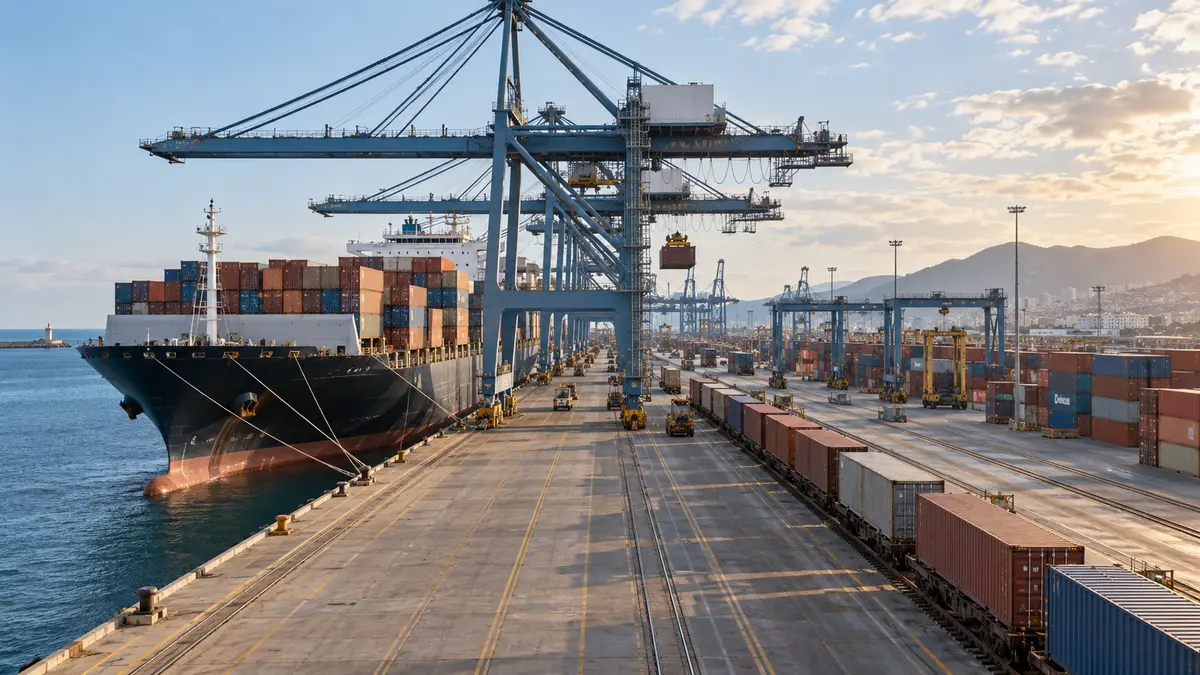
Iron ore created some of the world's largest and most regular bulk shipping routes. A change in destination alters voyage length, vessel utilisation, port compatibility and freight exposure. Growth spread across several smaller markets may not reproduce the efficiency of one enormous corridor.
Shipowners and traders need scenarios for tonne-miles as well as tonnes. A lower cargo volume travelling farther can support vessel demand, while a similar volume on shorter routes can weaken it. Congestion, weather and port draught also affect the number of effective ships available.
Long-term freight agreements can protect reliability but become costly when flows change. Flexible chartering preserves options but increases price risk. Miners should align shipping contracts with customer diversification rather than assume that historical routes remain optimal.
Decarbonisation changes which ore wins
Steel accounts for a significant share of industrial emissions. Mills are testing efficiency upgrades, more scrap, hydrogen-based reduction and carbon management. Each pathway changes the preferred raw material. High-grade ore and pellets can improve productivity and reduce the fuel required in existing furnaces; some direct-reduction routes demand particularly clean feed.
This creates an opportunity within slower volume growth. A miner can invest in beneficiation, concentrate or pellet capacity to sell a product that helps a customer meet emissions targets. The investment still needs rigorous economics because processing consumes water, energy and capital. A green premium cannot be assumed.
Measurement must be credible. Customers need consistent information about ore chemistry, processing emissions and logistics. Claims based on broad corporate averages may not support a mill's product accounting. Traceability and technical collaboration can become as important as extraction cost.
A board playbook for the post-boom market
Mining boards should begin with a demand range rather than one forecast. The range should separate Chinese construction, manufacturing and exports, then add scenarios for scrap substitution and emerging-market capacity. Price assumptions must reflect both demand and supply already committed.
Second, portfolios should be ranked by delivered cost, quality and carbon value. Management needs to know which tonnes remain competitive in a low-price year, which are needed to preserve customer blends and which depend on optimistic premiums. Replacement projects deserve different treatment from pure volume expansion.
Third, customer strategy must start before capacity is commissioned. Technical trials, credit arrangements, port design and shipping contracts take time. A future mill is not a buyer until its financing, construction and furnace plan are credible.
Steelmakers need an equally granular view. Ore price, coke, scrap, electricity, emissions and product mix determine competitiveness together. A mill that buys the cheapest ore can lose money through lower furnace productivity. Procurement and operations should optimise the metal unit, not the invoice alone.
The end of one boom is the start of allocation
The prospect of peak Chinese iron ore imports did not signal the end of steel. It signalled the end of an era in which one market's rapid expansion could conceal many weak decisions. China would remain the largest centre of demand and production, but marginal growth would be harder to earn and more exposed to property, exports, scrap and policy.
Future demand would be distributed across infrastructure, manufacturing and energy systems in several regions. India offered the largest visible growth path, while other developing markets added diversity. None could instantly replicate the combination of scale, ports and mills created during the Chinese building boom.
For miners, the durable response is lower cost, better quality, disciplined capital and early customer development. For steelmakers, it is flexible raw-material strategy and a credible route to lower emissions. For transport businesses, it is a network designed around changing tonne-miles rather than yesterday's destinations.
A peak is most useful when it changes behaviour before prices force the change. Companies that treat it as an exact date will argue about the wrong number. Companies that treat it as a shift from automatic growth to deliberate allocation can decide which mines, products and relationships deserve the next dollar.

















HOT NEWS INTERNATIONAL
Leave a comment