
 EN
EN RU
RUATLANTA, February 10, 2026 — UPS is deliberately surrendering a large stream of Amazon parcels, accepting lower package volume while it resizes the network around shipments that earn more per stop. The decision turns a familiar growth assumption on its head: for a carrier with heavy fixed assets, the busiest network is not necessarily the healthiest one.
Bloomberg Businessweek examined the uncertain road created by earlier operating choices and chief executive Carol Tomé's effort to move beyond dependence on Amazon deliveries. The reset is not a complete separation. It is a managed reduction intended to improve revenue quality while UPS rebuilds capacity, labour and automation around a different customer mix.
The largest customer was large but not sacred
Amazon represented 10.6% of UPS consolidated revenue in 2025, down from 11.8% in both 2024 and 2023. That concentration made the account strategically important, but revenue share alone does not reveal contribution after pickup density, sortation, transport, delivery complexity and negotiated rates.
UPS agreed to reduce the customer's volume by more than 50% by June 2026 compared with 2024 levels. The carrier continued to handle Amazon shipments; it chose to remove a substantial portion whose economics did not fit its return targets. Calling the change a lost contract would miss both the continuing relationship and the deliberate nature of the reduction.
Three numbers describe different parts of the reset
- 10.6% measures Amazon's share of UPS consolidated revenue during 2025;
- more than 50% is the planned reduction in Amazon package volume from the 2024 baseline by June 2026;
- 8.3% is the fourth-quarter increase in US domestic revenue per piece, not an increase in total parcel volume.
Price per parcel rose while domestic revenue fell
UPS reported fourth-quarter consolidated revenue of $24.5 billion. US domestic revenue declined 3.2%, primarily because expected volume fell, while revenue per piece increased 8.3%. The two movements can coexist: fewer shipments can produce more revenue per unit without lifting the segment's total sales.
This is the central wager. Low-yield volume can help fill a conveyor or delivery vehicle, but it can also consume peak capacity, add handling and force facilities to be sized for work that earns a weak return. Removing it helps only if fixed cost comes out with the parcels or if released capacity is filled by better business.

A parcel network cannot shrink on a spreadsheet
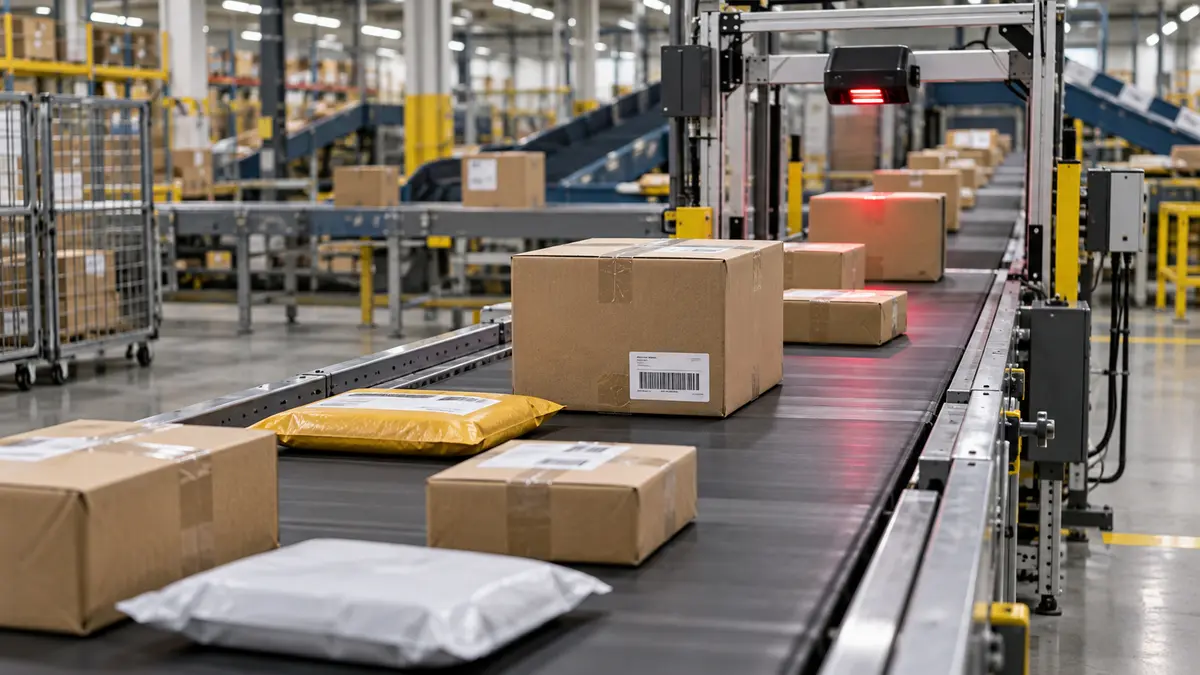
UPS operates an integrated air and ground system across the United States. Packages share buildings, aircraft, trailers, vehicles, technology and people. Taking millions of pieces out of that system changes the load at different places and hours rather than removing one neat, self-contained network.
The company therefore paired the customer glide-down with facility consolidation, workforce changes and more automation. Its 2025 annual filing said the operational workforce fell by approximately 48,000 positions, including 15,000 fewer seasonal positions, while daily operations ended at 93 buildings, both leased and owned. Eighty-five of those buildings were permanently closed.
Those figures mix permanent and seasonal labour effects and should not be treated as identical job eliminations. Likewise, ending daily operations at a building is not always the same as selling it. The relevant operating test is whether cost leaves at least as quickly as unprofitable volume without creating missed scans, late trailers or longer delivery miles elsewhere.
The replacement mix has different demands
UPS has pointed to healthcare, small and medium-sized businesses, international traffic and time-sensitive shipments as attractive markets. These categories can generate higher revenue per piece, but they are not interchangeable with standard e-commerce cartons. Healthcare logistics may require temperature control, chain-of-custody evidence and narrow delivery windows. Smaller shippers need convenient pickup, software and returns. International work adds customs and cross-border coordination.
Winning those shipments requires more than spare conveyor space. Sales coverage, digital tools, specialised packaging, visibility and exception management must all match the promise. A network optimised only by closing buildings could save money and still be poorly configured for the customers meant to replace the departing volume.

The 2026 forecast still carried transition risk
For full-year 2025, UPS recorded $88.7 billion of revenue and a 9.8% adjusted operating margin. Its initial 2026 outlook called for approximately $89.7 billion of revenue and an adjusted operating margin of about 9.6%, alongside roughly $3.0 billion of capital expenditure. The forecast did not promise an immediate straight-line margin gain during the final phase of the reset.
The annual filing warned that total average daily volume was expected to be lower in 2026 than in 2025. It also described continuing consolidation and process redesign. Guidance is a management estimate exposed to demand, fuel, trade, labour, execution and customer-mix risks, not a completed outcome.
Investors need a bridge from volume to value
A credible scorecard should separate what the strategy controls from what the economy supplies. Management can report Amazon pieces removed, buildings and shifts changed, automation deployed and expense taken out. It should then connect those actions to revenue per piece, service performance, network utilisation, operating margin and cash conversion.
- Track volume by customer group and service level rather than one network-wide total.
- Reconcile fixed, semi-variable and variable savings with the decline in pieces.
- Show whether higher-yield healthcare, international and small-business traffic uses released capacity.
- Measure on-time performance and claims so cost removal does not hide a service decline.
- Distinguish temporary transition charges from recurring operating economics.
Less can be worth more, but only after execution
The Amazon glide-down challenges the instinct that a delivery company must protect every parcel. UPS is betting that network quality comes from profitable density, not maximum density at any price. That logic is defensible, yet it creates a demanding sequence: remove weak volume, remove the right cost, preserve reliability and win specialised shipments before assets sit idle.
The natural headline is therefore not that UPS abandoned growth. It is that the company chose to rebuild the economics beneath growth. The proof will arrive when higher revenue per piece translates into durable margins and cash after the network has absorbed fewer Amazon boxes—not when a planned volume target is merely reached.
















HOT NEWS INTERNATIONAL
Leave a comment